Hardwood Floors After Water Damage — Can They Be Saved?
LocalFlow Restoration of New England
Why hardwood and water are a complicated combination
Hardwood floors are hygroscopic — they naturally absorb and release moisture as ambient humidity changes. In normal conditions, this is manageable and expected. After a water damage event, however, rapid and excessive moisture absorption can cause cupping (edges rise above center), crowning (center rises above edges), warping, buckling, and in severe cases, structural separation from the subfloor.
The good news is that solid hardwood is the most resilient flooring material for restoration. Because it can be sanded and refinished multiple times, cupped or lightly damaged solid hardwood that is dried properly can often be restored to excellent condition. The key variables are: water category, saturation depth, elapsed time before treatment, and species of wood.
When hardwood floors CAN be saved
Solid hardwood floors (3/4 inch or thicker) exposed to Category 1 (clean) water have the highest salvage rate. If professional extraction begins within the first 24-48 hours, moisture meters show saturation confined to the surface and upper portion of the plank, and the subfloor has not been significantly affected, the restoration pathway is: extract standing water, deploy directed air movers across the floor surface, monitor moisture content daily, and when the floor reaches equilibrium moisture content, allow it to stabilize and then sand and refinish to address cupping or discoloration.
Cupping in solid hardwood — where boards cup concave across their width due to moisture absorbed on the bottom — is not necessarily a death sentence. Mild to moderate cupping in solid hardwood that dries completely sometimes self-corrects significantly without sanding. Remaining cupping after drying is addressed during sanding and refinishing.
- Solid hardwood (3/4 inch+) exposed to clean (Category 1) water
- Professional extraction within 24-48 hours of the event
- Moisture saturation confirmed to be surface-level, not into subfloor
- Mild to moderate cupping — may self-correct during drying; address remainder with sanding
When hardwood floors CANNOT be saved
Engineered hardwood — which consists of a thin veneer of real wood over plywood layers — has very limited tolerance for water damage. The plywood core delaminates when saturated, and the thin veneer does not provide enough material depth for sanding. Most engineered hardwood that has been significantly wetted must be replaced rather than restored, regardless of apparent surface condition.
Solid hardwood exposed to Category 2 or 3 water (gray or sewage water) typically must be replaced in residential settings due to contamination absorption into the wood fibers. While the wood itself can theoretically be treated, the liability and health risk of retaining Category 3 contaminated flooring in a home is not defensible, and most insurance adjusters and restoration protocols call for removal.
Solid hardwood that has been saturated for more than 72 hours, that shows active buckling or separation from the subfloor, or that shows confirmed mold growth on the back face of planks also falls into the replacement category. Significant buckling that lifts the floor away from the subfloor creates structural damage that cannot be corrected by drying and sanding.
- Engineered hardwood: delamination of plywood core; replacement nearly always required
- Category 2 or 3 water exposure: contamination absorbed into wood; replacement required
- Saturation beyond 72 hours: mold likely established; assess carefully
- Active buckling or subfloor separation: structural damage requiring replacement
The drying process for salvageable hardwood
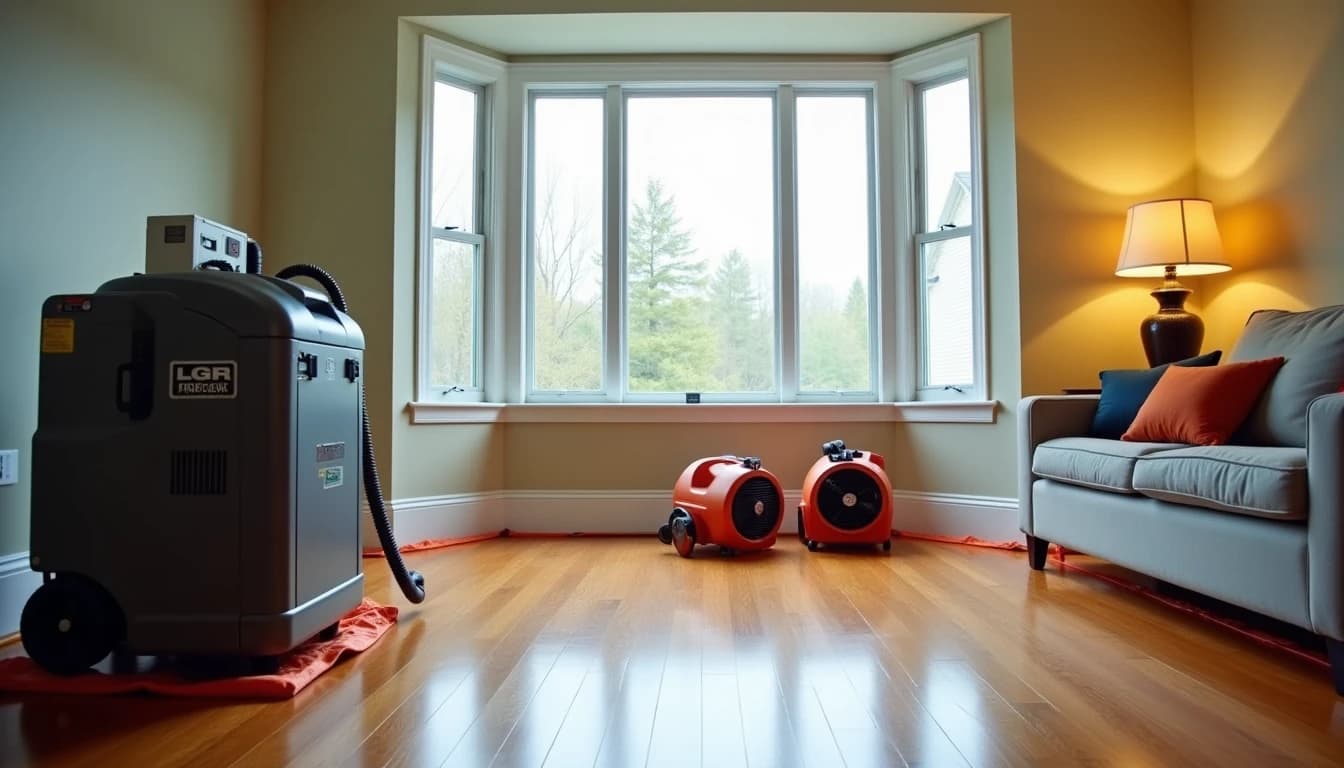
Professional drying of hardwood floors uses a combination of high-velocity air movers directed across the floor surface at low angles and, in some cases, specialized floor drying mats — flat panels connected to a negative pressure system that draws moisture upward through the floor. This floor mat system is particularly effective for reaching moisture in the subfloor assembly without tearing up the hardwood.
Moisture content is monitored using both pin meters (which penetrate the surface slightly to measure conductivity) and non-invasive flat-plate sensors. The target is to reach equilibrium moisture content (EMC) for the local climate — typically 6-9% in New England during heating season. Drying is not complete until the subfloor as well as the finished floor surface reach this range.
Low-grain refrigerant dehumidifiers keep relative humidity in the mid-40 percents so boards release moisture evenly; rapid over-drying the face while the underside stays wet worsens stress cracks and can lock in permanent cupping.
Frequently asked questions
Can I speed up drying by turning up the heat?
Increasing heat without increasing air movement and dehumidification raises ambient vapor pressure without significantly accelerating evaporation from the wood. It also increases the temperature gradient that can cause stress cracking in wood. Professional drying uses balanced air movement and dehumidification — not just heat. Follow your restoration company's equipment recommendations.
How do I know if my hardwood is solid or engineered?
Look at the edge of a plank, if one is accessible near a vent or threshold. Solid hardwood shows the same grain pattern throughout the thickness. Engineered hardwood shows distinct layering — a thin top veneer over plywood or HDF core layers. If you cannot determine this visually, your restoration company's moisture meter readings and sounding tests will quickly identify the construction type.
How much does it cost to dry and refinish vs. replace hardwood?
Professional drying of salvageable hardwood runs $1,500 to $4,000 for a typical room, plus $3 to $6 per square foot for refinishing. Replacement of solid hardwood runs $8 to $16 per square foot installed. For a 200-square-foot room, salvage may cost $3,500 to $5,200 versus $1,600 to $3,200 for replacement — which is why the salvage decision is made carefully based on actual condition rather than assumed to be cost-effective in all cases.