MA
Primary hubLocalFlow Restoration of New England
280 Corey Rd · Boston, MA · 02135
(857) 337-2202
IICRC Certified · Fully Insured · Carrier-Ready Documentation
When water enters your home or building, the clock starts immediately. Standing water wicks into drywall, subfloor assemblies, and insulation cavities within hours. LocalFlow Restoration of New England responds with truck-mounted extraction equipment, commercial-grade dehumidifiers, and psychrometric monitoring so your structure dries to the ANSI/IICRC S500 standard — not just to the point where it feels dry. Every loss is different. Category 1 clean water from a supply line failure, Category 2 gray water from an appliance or overflow event, and Category 3 black water from sewage backup each require distinct containment, disposal, and antimicrobial protocols. We assess on arrival, communicate plainly about what the contamination category means for your materials, and build a written drying plan before equipment is placed. Moisture logs, photo timelines, psychrometric readings, and signed drying reports travel with every job — because documentation is what separates a recoverable insurance claim from a dispute. Our certified technicians carry photo ID, arrive in marked vehicles, and do not expand scope beyond emergency strip-out without a written authorization. From pipe burst to storm infiltration to appliance leak, LocalFlow Restoration of New England structures every project around one outcome: a verified dry standard with a paper trail your adjuster can work from.
IICRC Certified · Licensed & Insured · Insurance Documentation Specialists
Response Priority
Emergency dispatch available
Certification
IICRC Water Damage Restoration Technician
Documentation
Carrier-ready drying logs every job
Coverage
Works directly with all major carriers
SATISFACTION GUARANTEE
LICENSED & INSURED
SAME·DAY SERVICE
FREE ESTIMATES
What We Restore
From the first extraction visit through final moisture clearance, LocalFlow Restoration of New England handles every phase of the restoration process — structural drying, mold containment, sewage remediation, contents pack-out, and rebuild coordination. One call covers the entire project scope.
Air scrubber & HEPA deployment strategy from LocalFlow Restoration. Manufacturer-authorized service, written quotes, photo documentation.
Attic water damage restoration from LocalFlow Restoration. Manufacturer-authorized service, written quotes, photo documentation.
Basement flood cleanup in your area — LocalFlow Restoration of New England. Documented drying logs, containment when needed, and carrier-friend...
Basement waterproofing after water damage from LocalFlow Restoration. Manufacturer-authorized service, written quotes, photo documentation.
Biohazard cleanup & decontamination in your area — LocalFlow Restoration of New England. Documented drying logs, containment when needed, and c...
Burst pipe water damage in your area — LocalFlow Restoration of New England. Documented drying logs, containment when needed, and carrier-frien...
Our Process
Four structured phases protect your property and keep your claim organized from arrival to clearance.
Certified technician arrives within hours, runs infrared moisture mapping, documents contamination category, and begins truck-mounted extraction. Hidden saturation under finishes is scoped before any demolition.
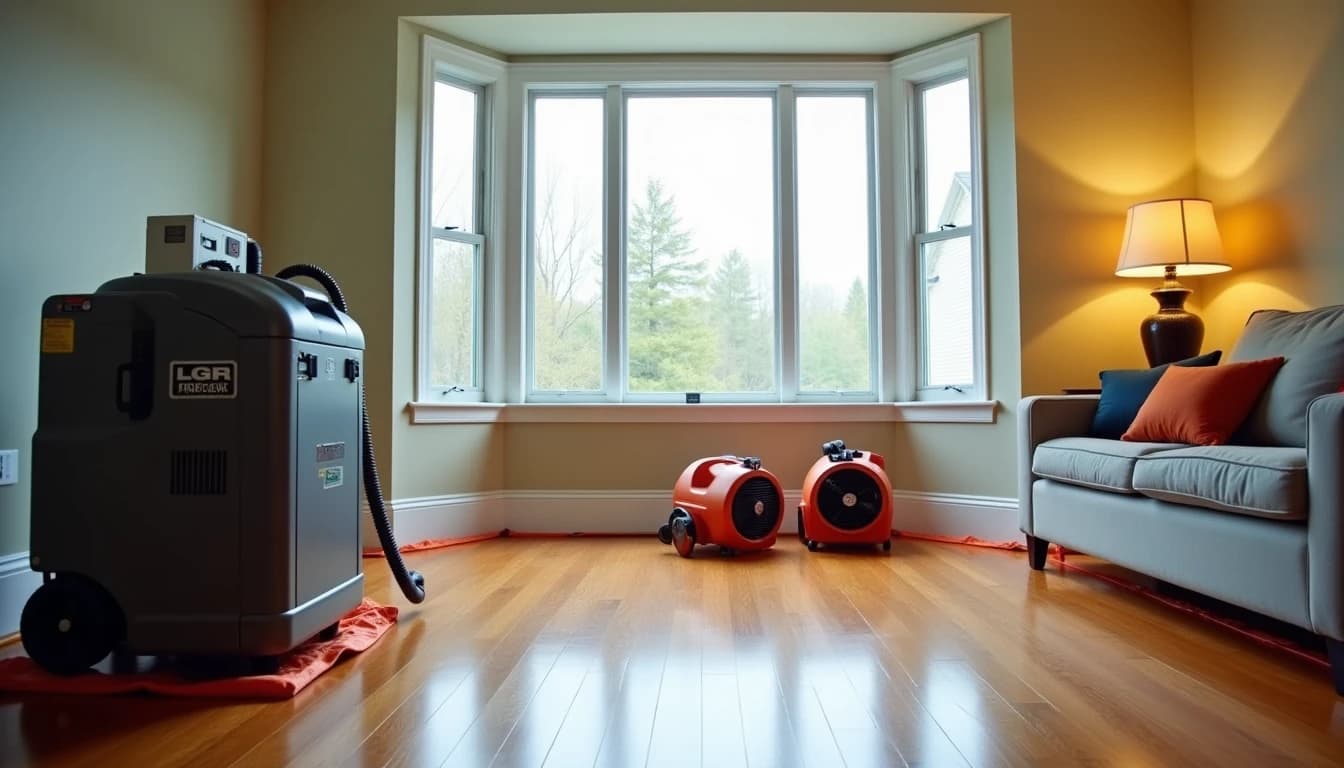
Poly-barrier containment isolates wet zones. LGR or desiccant dehumidifiers paired with directed air movers follow a written equipment placement map. Cavity venting opens wall assemblies where meters indicate hidden saturation.
Daily temperature, relative humidity, and grain depression readings per zone — emailed to you and your adjuster. The drying plan adjusts in real time if a zone is not trending toward the ANSI/IICRC S500 dry standard.
Final survey confirms dry standard zone by zone. Closeout package — baseline readings, daily logs, equipment maps, clearance photos — delivered for your carrier file. Rebuild trades return only after written clearance.
Our restoration company was built around a single operational principle: documentation protects property owners. The entire workflow follows IICRC standards — moisture readings per zone, daily psychrometric logs, and signed scope authorizations before invasive demolition. Every technician is trained to IICRC Water Damage Restoration Technician standards with calibrated equipment so readings are defensible, not estimated. Category 1, 2, and 3 contamination each get their own PPE, disposal, and antimicrobial protocols — no shortcuts to simplify billing.
Recent Work
Every project below was completed using the same documented, IICRC-guided process: moisture mapping on arrival, written drying plan, daily psychrometric logs, and carrier-ready documentation at closeout. Details are shared with permission; location identifiers are generalized to protect property owners.
Residential property
Commercial building
Multi-family unit
The faster water is extracted and structural drying begins, the smaller the affected square footage — and the smaller the claim scope. Every hour of delay allows moisture to wick deeper into wall assemblies, subfloor systems, and insulation cavities. LocalFlow Restoration of New England prioritizes emergency extraction dispatch because early intervention is the most effective mitigation we can provide. When you call, a project manager triages the contamination category with you on the phone, confirms equipment availability, and gives you an honest arrival window — never a promise we cannot keep.
Certified technicians · Marked vehicles · Written scope before invasive work begins
Straight answers about timing, pricing, and what to expect.
Yes. Sewage and contaminated floodwater events are handled under a separate Category 3 protocol that includes full PPE, containment of affected areas, antimicrobial treatment, and disposal of non-salvageable porous materials per Massachusetts DEP guidelines. Post-remediation testing is available to confirm pathogen levels have returned to background before the space is reoccupied.
Yes. Commercial large-loss events are a core part of our service offering. We can mobilize multiple extraction and drying units and coordinate with building management, tenant representatives, and insurance adjusters simultaneously. Our first on-site meeting addresses business continuity — which areas must reopen first, how tenant operations continue during remediation — so recovery proceeds without unnecessary downtime.
Yes. Insurance documentation is a standard part of every job — not an add-on. We capture timestamped photo sets at intake and closeout, produce moisture logs in adjuster-ready format, and coordinate directly with major carriers and public adjusters. Our scope narratives are written in language aligned with insurance guidelines to minimize back-and-forth and accelerate claim approvals.
Engineered veneers rarely tolerate more than one aggressive sand; solid species tolerate more if contamination is absent. Subfloor moisture must match finished floor EMC before reinstallation. Cup that lifts fasteners from subfloor tongue indicates structural replacement, not cosmetic sanding alone. Stain blotchiness after first sand pass often signals absorbed Category 2 water that replacement will address more honestly than repeated color trials.
Drying is complete when all affected materials reach manufacturer-specified equilibrium moisture content — not simply when the room looks or feels dry. We log moisture readings daily throughout the drying period and adjust equipment placement as conditions change. The job closes only when every reading is at or below clearance threshold, and we document the final readings for your insurance file.
Average response time within the our primary service area is two to four hours from first contact. After-hours emergencies are routed through our live answering line at (857) 337-2202. The on-call coordinator assesses severity, dispatches the nearest crew, and provides a real-time ETA update.
Wide shots with timestamps, ruler references for water height, and serial photos of source appliances speed approvals. Capture serial plates before anything is moved so subrogation targets stay clear. Video walkthroughs narrating active drips help time-stamp when mitigation actually began versus homeowner delay.
Yes. All water damage assessments are free. A technician visits your property, takes moisture readings, and provides a written scope estimate at no charge. Work begins only after you review and approve the written scope. The invoice at completion matches the approved estimate — no surprise charges are added without prior discussion and authorization.
Our offices
3 offices — call or get directions from the one nearest you.
MA
Primary hub280 Corey Rd · Boston, MA · 02135
(857) 337-2202
MA
11 George Brown St · Billerica, MA · 01821
(978) 330-1262
MA
121 Tremont St # B · Brighton, MA · 02135
(857) 425-1468