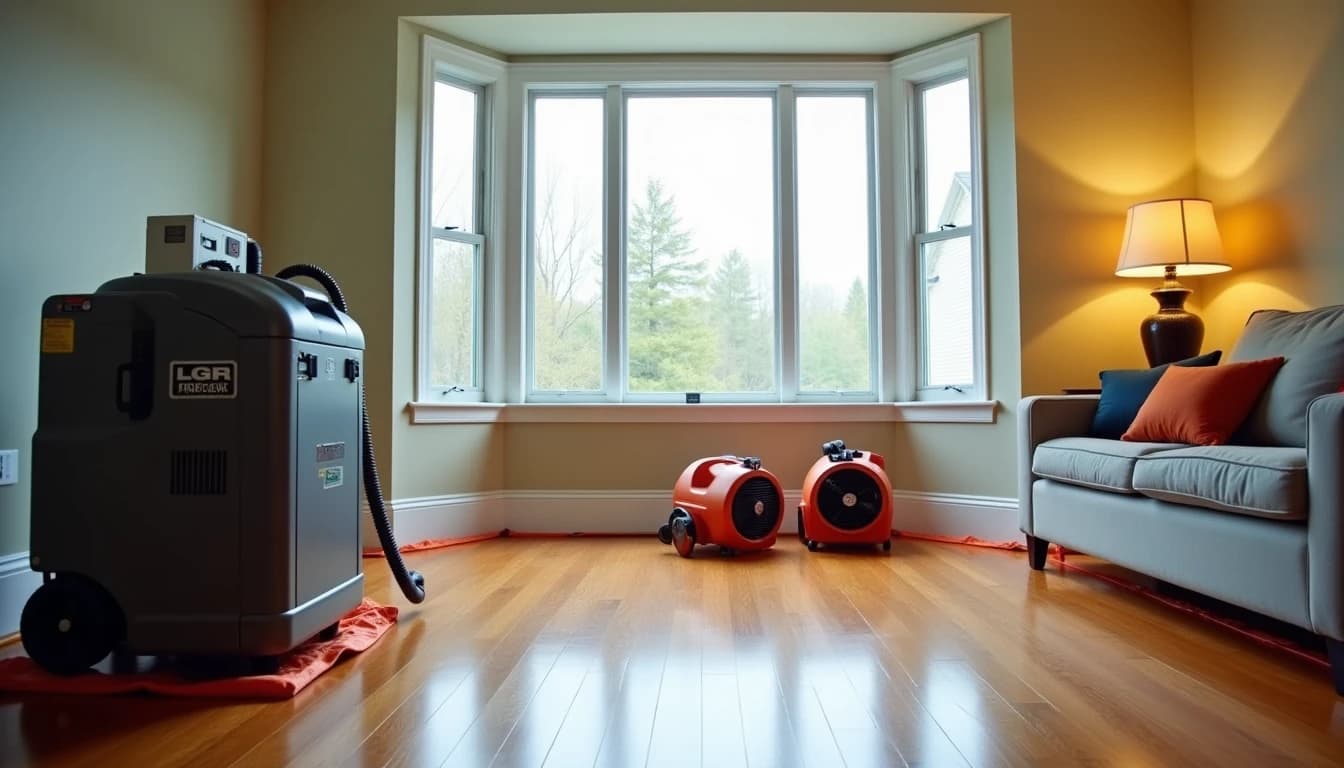
How Structural Drying Works — What Professional Equipment Actually Does
LocalFlow Restoration of New England
Why consumer drying equipment is not sufficient
After a water damage event, homeowners often deploy box fans and consumer dehumidifiers from a hardware store. While these tools are useful for surface drying and reducing ambient humidity in small spaces, they are fundamentally inadequate for structural drying — the process of reducing moisture content in wall assemblies, subfloor systems, ceiling cavities, and other structural components to below 16% moisture content (the threshold below which mold cannot sustain growth).
Professional restoration companies use a combination of equipment designed specifically for structural drying: high-velocity axial and centrifugal air movers, commercial-grade low-grain refrigerant (LGR) dehumidifiers, desiccant dehumidifiers for extreme conditions, thermal imaging cameras, and calibrated moisture meters. The combination of directed air movement and high-capacity dehumidification creates a controlled drying system that accelerates evaporation from within building assemblies.
Air movers — the foundation of structural drying
Air movers are the primary workhorse of structural drying. Unlike household fans, which move large volumes of air at low pressure in broad patterns, professional air movers (also called 'snail shells' due to their centrifugal housing design) direct high-velocity, low-volume airflow at specific angles across wet surfaces. This directed airflow disrupts the boundary layer of still, humid air that forms on wet material surfaces and accelerates evaporation at the material surface.
A standard residential water damage job may use 8-12 air movers depending on square footage. They are positioned at a 45-degree angle to walls to create a vortex airflow pattern that draws moisture from wall cavities and carpet/pad assemblies. The IICRC recommends a minimum of one air mover per 50-100 square feet of affected area, though actual placement depends on the moisture map.
Air movers run continuously — 24 hours a day — throughout the drying period. Restoration technicians monitor moisture readings daily and adjust placement as materials dry. This daily monitoring is what distinguishes professional drying from leaving consumer fans running and hoping for the best.
- Centrifugal design creates high-velocity directed airflow at wet surfaces
- Positioned at 45-degree angles to create vortex patterns reaching wall cavities
- One air mover per 50-100 square feet as a starting baseline
- Run continuously 24 hours/day; repositioned daily based on moisture readings
LGR dehumidifiers — removing evaporated moisture from air
Air movers evaporate moisture from surfaces and push it into the air. Without simultaneously removing that moisture from the air, you simply raise ambient humidity to the point where evaporation stops. Commercial LGR (low-grain refrigerant) dehumidifiers are designed to remove large quantities of moisture from air even at low relative humidity levels — a capability that consumer dehumidifiers lack.
A commercial LGR dehumidifier can extract 100-200 pints of water per day from a room's air at 80°F. Consumer units extract 30-50 pints per day in ideal conditions and lose efficiency significantly as humidity drops below 60% RH. Professional units continue extracting efficiently at 40% RH and below — exactly the range at which structural drying operates.
Dehumidifiers are sized to the volume of air being treated and the estimated moisture load from the affected structure. The collected water is discharged to a floor drain or an exterior hose. Technicians record the amount of water extracted daily as part of the drying log — a direct measure of how much moisture is being removed from the structure.
- Commercial LGR units extract 100-200 pints/day vs 30-50 for consumer units
- Maintain efficiency at 40% RH — where consumer units lose most effectiveness
- Sized to air volume and estimated moisture load of structure
- Daily water extraction volumes are logged as part of the drying documentation
Monitoring and daily moisture mapping
Professional drying is not a 'set it and forget it' process. Restoration technicians return daily to measure moisture content in structural materials using calibrated pin meters (which measure conductivity in wood and drywall) and non-invasive sensors (which use electromagnetic waves to detect moisture without penetrating the surface). Readings are recorded on a moisture map — a floor plan showing the moisture content at each measurement location.
Drying is declared complete when all affected materials have reached equilibrium with normal, dry building materials — typically below 16% moisture content for wood and below 1% for gypsum. The drying log documents this progression and serves as evidence for the insurance claim that drying was thorough and complete.
When moisture readings plateau and stop declining — indicating that the equipment is no longer moving water out of the structure — technicians evaluate whether structural opening (cutting drywall access holes to expose cavities) is needed, or whether the remaining moisture is acceptable.
Frequently asked questions
How long does professional structural drying take?
Most residential water damage events dry in three to five days with professional equipment. Category 2 and 3 events, flooring assemblies with concrete subfloor, or events where remediation was delayed may take seven to ten days. After drying is complete, the equipment is removed and reconstruction can begin.
Can I rent professional dehumidifiers myself?
Commercial drying equipment is available for rent at some equipment rental companies, but without proper moisture mapping and daily monitoring, you cannot optimize placement or confirm when drying is complete. Improper structural drying that leaves residual moisture above 16% will result in mold growth within weeks — often inside walls where it goes undetected until it is a significant remediation project.
Do I have to be home while the drying equipment runs?
No. Drying equipment runs 24/7 and your restoration company will have you sign an equipment placement agreement. The technicians will visit daily for moisture monitoring, typically during business hours. They will coordinate access with you and provide advance notice of each monitoring visit.